ZOX Wisdom Chapter 1 – Mental Photography Photographic Memory Enhancement

4 Methods for Better Memory & Learning

ZOX Pro Method is Over 10 Times More Effective than Others

Forgetting an anniversary can be fatal. Secret natural photographic memory method Mental Photography grows memory via neuroplasticity over memory techniques, including Mnemonics, due to a new approach for memory growth and restoration, reveals ZOX Pro is over 10 times more effective than other memory trainings and memorization methods. Comparison of Mental Photography with other top memory training techniques included below.

string-on-finger

Top 10 Problems for Most People includes Memory 

“Anniversary Oversight” can Kill a Relationship

Forgotten  something that was important to someone else? Actually, it happens all the time. In this fast paced world sometimes it is difficult for people to find the time to remember important things. What may be important for one person, may not be priority for the other person. Take names for instance. Most people forget the names of important people around them. It could be at their job, or in their professional environment. It could even be family members. Just think how many sit-com episodes have been created on the man forgetting his Anniversary or the wife’s Birthday.

So remembering things seems to be something a person should take extra care to do. Keep in mind. All those nice little digital devices are fallible. They are programmed to provide a response. That is, unless they were programmed by the person that ‘forgot’ the instructions. So, if the instructions are missing and cannot be found on line, the relationship may be in grave danger of “Anniversary Oversight”; a sure deal breaker.

Stress is a Name Killer

Whether the board meeting or the company picnic, people take the opportunity to impress others. However, it does not impress people when their name is forgotten during an introduction. Even though these meetings can provide opportunity, they can lure disaster into the recipe. People in this environment are under stress to perform. If they don’t perform well, stress levels go up and the disaster is more likely.

Memory Strategy – Plan Ahead

What does better Memory mean?

Often we will see demonstrators that make a living from grand-standing for a memory course. They will enchant us with how “they” can memorize names and occupations of 100 people in a couple of minutes, using a particular technique.  “Wow!” screams the audience, ” that is we want! …no more embarrassment!”

Memory Trainings

There are relatively 4 different types of memory training. They are listed here in order to the frequency how often they are taught to the public:

Rote Memory – This is the method taught in school.  Repetition –  simply keep going over the same information time and again until it is memorised. Consumes the most amount of time and effort. Efficient only for the specific information dealt with in this matter. Once this type of information is forced over into the long term memory, the person feels like he learned it.

As this is you first real exposure to a taught technique, it has low efficiency, but due to repetition, it tends to have lasting long term memory.

~~~~~~~~~~~~~~~~~~~~~

Cup & Hook (associative) Method – This is the method usually seen in action when a memory course demonstrator is going around the room learning names. The basic premise is similar for this style – the person will assign something that symbolises or represents certain characteristics around the specific thing he wants to remember.  This is a good method and it is effective in most circumstances. It gives a structure to follow. If the person stops using it for a period of time, he must go back to the beginning and start building all over again. It does not permanently build structure in the brain, at least not in the short term. Maybe those areas would improve over a great amount of time and continual practice.

Usually touted as a memory trick, it is generally the second style learned. It can give a quick fix, but is not lasting. so is not very effective. The efficiency varies with the amount of ongoing practice, and does not support lasting long term memory.

~~~~~~~~~~~~~~~

Mnemonics – This is a series of 9 different types of memory strategies. Once a person learns all of them and how to properly use them, then they can be applied in many ways: Music or lyrics, names (ROY G. BIV = Red, Orange, Yellow, Green, Blue, Indigo, Violet), words or expressions, models and diagrams, rhymes, notes or note cards, outlines, images, connections and spelling are the different types.

Each type is different and can be applied differently.  To become good at all of them would be a considerable undertaking.  If a person is willing to put in the time to understanding and using them, it is quite a formidable package. To have a good understanding in all of them should come with a medal; for sheer determination.

Typically this is the third style taught, as it is meant for serious memorizing. The efficiency is high, but comes at a price.  Best used for passing detailed testing, and remembering specific details. It does have lasting long term memory, but is similar to previous styles due to cross-exposure of information, memories are likely to last longer in this format, as they often have a connecting structure built around the concept or word, and building links to other associative memories.

~~~~~~~~~~~~~~~~~~~

Mental Photography

Mental Photography works in a very different way. The method places gaining Memory second behind gaining access to the Photographic Memory.

Even though being very effective for memory building, Mental Photography uses and exercises another natural brain function first – the Photographic Memory. By stimulating the photographic memory (eidetic memory) and delivering information at high rates of speed that pushes the serviceability of the brain. Through neuroplasticity, the brain triggers production of more neurons, synapses, and dendrites. All of this action in the brain essentially adds or grows more memory. Once more memory and connections are available, then accessing memory for any purposes is much easier.

This building process does not happen overnight. There are billions of neurons and trillions of connections within the structure of the brain. This dynamic action creates more neurons that will be connected into the rest of the system to increase memory.

Since Mental Photography is usually used foremost for large volume information retention, it is a wonderful benefit to actually grow more usable memory as by-product  of exercising the brain in this way.

This method is exclusive, and is the forth method discussed here, but it is also the most powerful of any memory technique. It approaches memory differently, using the completely natural functions of the brain

The efficiency rating of Mental Photography is excellent:.

Information Retention >50,000 wpm or more

Memory gain – High to infinity.

More use  will stimulate further growth. No limitation known. Time spent creates results in many areas using 1 basic set of exercises. Daily use gives better and ongoing results.

The lasting long term memory is excellent, with approximately 100% for life.

Mental Photography was invented in 1975 by Richard Welch, PhD,” the Father of Mental Photography”. Mental Photography is at the core of the teachings of Brain Management and ZOX Pro Training. These trainings also have many more benefits not mentioned here.

~~~~~~~~~~~~~~~~~~

Memory is important. Consider the options. These methods range from short term fixes to life-long gain. Make this year the “Year to Remember”,

Don’t Forget…

Shannon Panzo, PhD

Attention… Business Owners and Managers

Our organization is considering business opportunities for those professionals that see the Mental Photography as a good objective for their clients and businesses. Please connect with us by email with expressions of interest.


 

“Great Things Happen Here!”

Get Better Memory & Stop Forgetfulness in the New Year

Get Better Memory

Stop Forgetfulness

Most People include ‘Memory’ in their Top 10 Problems

photographic memory, memory, training

REMEMBER


Embarrassing…  isn’t it?

Picture yourself in the company of many respected people in your line of work or profession. It can be a highly charged situation, with jousting and sabre-rattling. You must be at your best. You bump into someone important or want to introduce someone, just to find you have forgotten their name.

This is the typical stressful situation you are most likely to forget – when it is most important. When you know your memory is not as sharp as what it should be it raises the stress level. Your confidence plays a big part in allowing memories to traverse the canyon into the now. Likewise, if you are not confident, even the correct memory can fall into the abyss. Opportunity missed.

If you are not affected by this, then you probably know someone that is; a friend or family member, a colleague or co-worker, or perhaps a manager. Of course business managers are supposed to know all the people they come in contact with right? Only in a dream for most.


What does Your Memory mean to You?

Your memory and the ability to use it is a precious asset. Your memory contains the sum of all of the experiences you have had throughout life. If there is any one thing in life that defines a person, it is their memory. It has made them what they are, it shapes the way they react to events, and often shows the experience level a person achieves in life. Take every step possible to keep it functioning well. Without memories, a person becomes empty and separated, with feelings of loneliness and uselessness.

If you find you have difficulty remembering your children’s names, then you better take a firm grip on your reality and get some help fast. If it is nothing, then you have not lost anything in having it checked.


Memory Misplacement

This has become  such an issue for people, there are tons of memory courses on the market, that are positioned to salvage your dignity along with your memory. Many of these follow the “Peter Principle“, and will only take you to the highest level of incompetency.  It is likely that you would rather stay in a system that is unwieldy and difficult for you, than to find a different system that works for you. (The same thing happens when people are ‘readers’.)

Often we see demonstrators that make a living from grandstanding to promote a memory course. They will enchant us with how “they” can memorize names and occupations of 100 people in a couple of minutes, using a particular technique.  “Wow!” screams the audience, ” that is we want! …no more embarrassment!” Yes, there are courses that will train you how to do likewise. What is involved? Will it automatically be there for you at any time you need to use it in the future? Unless you continually refresh it, probably not. Is that type of training for you?


My Experience in the Brain Training Game…

I have reviewed far too many memory trainings than I wish to think about over the years. Perhaps I was looking to stumble over the “magic pill” romance that many are led to believe. I have never found any sign of that magic pill, unless you just happened to be wired up that way to start with. Granted, most are not.

Memory training is a critical part of what Brain Management is all about. Brain Management first deals with accessing the NATURAL Photographic Memory, then stimulating memory growth naturally as a by-product of exercising the brain in this fashion. I have been presenting Brain Management for many years, and have consistently heard from our clients our training should be marketed more for the memory enhancement you get from it.

IMPORTANT: There is one thing above all else to consider when discovering the best memory training for you. If it does not feel natural, then you will probably stop using it.


Memory Trainings

There are relatively 4 different types of memory training. (To keep things easy to understand, we are stopping at 4 styles, although more are available.) I have listed them in order to the frequency how often they are taught to the public:

Rote Memory – This is the method you learn in school. This is when you simply keep going over the same information time and again until you have memorised it. Consumes the most amount of time and effort. Efficient only for the specific information you have dealt with in this matter. Once this type of information is forced over into the long term memory, you feel like you learned it.

Taught – First

Efficiency – Low

Lasting Long Term Memory – Yes


~~~~~~~~~~~~~~~~~~~~~

Cup & Hook (associative) Method – This is the method you will usually see in action when the demonstrator is going around the room learning names. The basic premise is similar for this style – you will assign something that symbolises or represents certain characteristics around the specific thing you want to remember.  This is a good method and it is effective in most circumstances. It gives you a structure you can follow. If you stop using it for a period of time, you must go back to the beginning and start building all over again. It does not permanently build structure in the brain, at least not in the short term. Maybe those areas would improve over a great amount of time and continual practice.

Taught – Second

Efficiency – Varies with the amount of ongoing practice.  Loses effectiveness fast.

Lasting Long Term Memory – The efficiency of the method fades over time. But some memory may be picked getting through rote, from exposure.


~~~~~~~~~~~~~~~~~~~~~

Mnemonics – This is a series of 9 different types of memory strategies. Once you learn all of them and how to properly use them, then you can use them in such ways:


  1. music or lyrics
  2. names (ROY G. BIV= Red, Orange, Yellow, Green, Blue, Indigo, Violet)
  3. words or expressions
  4. models and diagrams
  5. rhymes
  6. notes or note cards
  7. outlines
  8. images
  9. connections and spelling


Each type is different and can be applied differently.  To become good at all of them would be a considerable undertaking.  If a person is willing to put in the time to understanding and using them, it is quite a formidable package. To have a good understanding in all of them should come with a medal; for sheer determination.

Taught – Third

Efficiency – High, but comes at a price.  Best used for passing detailed testing, and remembering specific details.

Lasting Long Term Memory – similar – due to cross-exposure of information, memories are likely to last longer in this format, as they often have a connecting structure built around the concept or word, and building links to other associative memories.


~~~~~~~~~~~~~~~~~~~~~

Mental Photography – Mental Photography works in a very different way. This method places memory as second to photographic memory.

Even though being very effective for memory building, Mental Photography uses and exercises another natural brain function first – the Photographic Memory. By stimulating the photographic memory (eidetic memory) and delivering information at high rates of speed that pushes the serviceability of the brain. Through neuroplasticity, the brain triggers production of more neurons, synapses, and dendrites. All of this action in the brain essentially adds or grows more memory. Once more memory and connections are available, then accessing memory for any purposes is much easier.

This building process does not happen overnight. There are billions of connections within the structure of the brain. This action creates more neurons that will be connected into the rest of the system to increase memory.

Since Mental Photography is usually used foremost for large volume information retention, it is a wonderful benefit that you are actually growing more usable memory as by-product  of exercising the brain in this way.

Taught – Forth

Efficiency – Excellent…

Information Retention >50,000 wpm or more

Memory gain – High to infinity.

More use  will stimulate further growth. No limitation known. Time spent creates results in many areas using 1 basic set of exercises. Daily use gives better and ongoing results.

Lasting Long Term Memory – Excellent – approximately 100% for life.

More than any other method, Brain Management (and ZOX Pro Training) uses Mental Photography at the core of its’ teaching. Mental Photography was invented by Richard Welch, PhD, my Mentor and colleague. I have worked directly with him since 1986.


~~~~~~~~~~~~~~~~~~~~~

If memory is important to you, and you want to make 2017 a Year to Remember, then you should consider your options as I have presented here. Brain Management, Mental Photography, and ZOX Pro Training have many more benefits than have been discussed in this article.

Shannon Panzo, PhD


Attention… Business Owners, Managers, and Human Resources…

Our organization is considering business opportunities for those professionals that see the Mental Photography as a good objective for their clients and businesses. Please connect with us by email of you are interested in pursuing this.

“Great Things Happen Here!”

memory training, photographic memory


[Video] Get a Better Memory, Forgetting, Hippocampus

All About Your Memory? Don’t Forget…

Memory (Short Term and Long Term Memory)

You have both a short term and long term memory…. both have their purpose… has the education system unknowingly hurt your long term memory by its teaching methods….

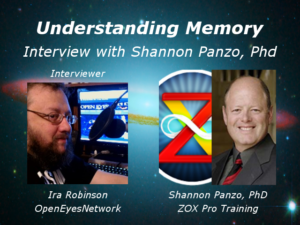
Listen in as Shannon Panzo, PhD has a fascinating conversation on Open Eyes sharing about Understanding Memory and the different reasons behind short and long term memory… and how we all can be photographic memory superstars….

  • Hippocampus, the part of the brain responsible for short term memory and its function is to flush and forget things after 48 hours…
  • How the written language has actually affected our ability of how we memorize things
  • What is “Hollywood” Photographic Memory…
  • A 5 year old child has better brain plasticity and can learn faster than you…
  • News media gets it totally wrong when reporting that Speed Reading doesn’t work
  • Daydreaming in class was actually helping you learn better
  • You have the ability to take in 50,000 words per minute and have it go directly into long-term memory where it stays there forever…and more…
Shannon Panzo Interview - Memory, Hippocampus, Forgetting

Understanding Memory – Shannon Panzo, PhD

 ⇓ ⇓ Video Below ⇓ ⇓

What is memory?

I constantly have people asking me about memory.

Forgetting…

Why do I forget things? Why do I forget what I just read?

Better Memory

How can I make my memory better?

Photographic Memory

How does the photographic memory fit into this?

Short term memory vs long term memory?

Memory Discussion

What happens if you lose your memories? It often happens to people that are elderly. It also happens to people at any age and for many different reasons. Your brain is highly complex and makes trillions of connections each day. It is easy to see how something so complex could easily be derailed.

The best solution are activities that can prevent a complete collapse if things should take a turn for the worse. You can exercise your brain to be stronger. It has been scientifically proven that when you exercise and stress your brain past the threshold of neural plasticity, it triggers your brain to immediately respond by building new pathways, synapse, neurons, and memory. Building this within your brain makes it resilient; resistant to memory loss, Alzheimer’s Disease, and dementia.

I recently was interviewed on the topic of “Taking Control of Your Memory”. If you are interested at all in memory, you should listen to this interview. I cover a lot of topics around memory in the Interview. Even if you do not hear what you need at the start, keep listening. The essential information you need could be covered next. This interview could be the most important thing you have ever heard.

Shannon Panzo Interview – Understanding Memory

Important Points within Interview…

About the Hippocampus…

The short-term memory revolves around a particular structure within the brain is called the hippocampus.

The hippocampus is actually part of the limbic system, a primitive part of the brain; and if you ever want to increase your ability to memorize things, on a conscious level, the hippocampus is stimulated.

The function of the hippocampus is to forget; not to remember. What the hippocampus thinks is not important, it just forgets it. Only ~5 percent of the initial memory is passed over to the long term memory.

There are ways to bypass the hippocampus and actually take in information driving it straight home to the long-term memory where you never forget it; mainly by using the photographic memory you are born with.

Human Memory…

Aboriginal cultures quite often demonstrate they have extensive memory because they have entrained the memories. Because there is no written language they are able to recite the songs of the stories exactly the same way each time for thousands of years. Their natural memory is stronger than the average human that relies on the written language and technical devices that store information. People that tend to take a lot of pictures of their self, where they are, and what they are doing and with whom, often demonstrate incredibly poor memory.

Reading vs. photographic memory

When you learn to read, you are instructed to close off your access to the photographic memory. The two, reading and your photographic memory, are actually in opposition to each other and by doing so you take away something very important to your development.

Information is the key asset to any decision making process. If you have good information your decision-making process is more successful. If you don’t have good information your decision-making process will give you poor output, and it will not be reliable. This is why some people make really great decisions and some people don’t, simply based on the quality of information. Information is treated equally in the brain. It’s the importance at which we bestow upon information as to how our brain treats it.

The Myth about Reading…

The establishment has been lying to everyone about reading, from the start. The lie is very low key. When you are first taught to read, it starts. As a child, you do not have a point of reference to this as non-truth, so you don’t even understand the nature of the lie, “in order to get the information you must read every word verbatim”. As a child, you do not have information to denounce it as a lie, so you accept it through acquiescence. It becomes part of your reality.

Restoring your photographic memory…

As you walk through stores, your photographic memory is being stimulated and exercised. Every store you go into has things setting on the counter and shelves for you to buy. The packaging that those things come in are laden with subliminal advertising. The subliminal advertising actually utilizes your photographic memory to program you to buy stuff. But it also prepares your mind to take over the strengthened photographic memory to use for your own benefit. The method that gives control of your photographic memory back to you is Mental Photography.

After learning Mental Photography with our methods, subliminal advertising simply bounces off. You regain your ability to decide what you choose to buy, instead what others are choosing you to buy. Have you ever bought something you do not want, need, or have a use for? That is result of subliminal advertising. You can change it.

Learning in the Alpha State of Consciousness…

If a child is daydreaming, staring out the window of the classroom while the teacher is talking about whatever the topic is of the day, the child will typically learn so much more than the average person in the class because they’re already in the state of alpha – as they’re looking out the window daydreaming.


Great Things Happen Here!

memory, forget, hippocampus

Photographic Memory — Keys to Success

Photographic Memory and Genius…

photographic memory

Photographic Memory is also known as “Eidetic Memory.”

So just what IS photographic memory? It’s a secret you’ve had since before you were born! If you still don’t understand, look to your children.  They will show you the way.

The infant brain develops even in the womb. Experts say you should read to your children as soon as they are born for quality stimulation of their natural learning abilities. As a child ages through that first crucial year of life, they are learning how to learn. The more stimulation – the more learning capacity the child will have.

Some people with photographic memory retain their photographic memory into adulthood. If you aren’t one of those people, why not? The answer will SHOCK you.  Are you ready?

Learning Begets Learning

One word. Reading. You see, we never lose our photographic memory. But many of us lose the ability to USE it, or more accurately, we lose access to it. You learned amazing things as a small child – languages, social skills, etc.

THEN, you went to school to learn a superior way to learn – or so we’re told.  Statistics show that once we enter school and become entrenched in the rote-memory system of learning; learning slows from that point on.

Your Inner Child Genius

The truth is, you were force fed learning to read, or you were ostracized. Some of those renegades who endured being ostracized are the same ones who have retained their photographic memories as adults.

Reading is  a brain function that encourages tunnel vision, which is directly opposed to your natural ability to access and use your photographic memory.

But with Mental Photography you can learn how to access your photographic memory and how to develop a photographic memory fast, and regain the genius you had as a child. By exercising your brain this way, you may see other things start to happen – and you don’t have to give up reading, either!

Your Future Starts NOW!  

Shannon Panzo

Great Things Happen Here!

Mental Photography and Brain Management

If you lived to 500 years old… You need Brain Management and Mental Photography

From Mind To Mind (MINDtoMIND.com), Thank you for taking time to read this important information. This article reveals one of the the greatest assets you can ever obtain for yourself. It is important that you not ignore how much impact it would have on your life.

If you lived to 500 years old,…
you might stand a chance to read all the articles on

#Wikipedia, or a quarter of the books on

Amazon.com

Unfortunately we do not live to 500, and would need a fortune to buy half of the books on Amazon.com, so how about a solution that fits into one lifetime and you can use within a few days to gather all the #knowledge you could ever desire!

At this moment, there are over 5 million articles on Wikipedia or over 10 Billion words of #information and knowledge. There’s an even bigger number of books (and another million published each year!) that you can buy on Amazon.com and that’s well over 100 Billion words of information. An average reader can get through 250 words per minute.

Don’t worry — we’re counting how fast you read right now!

So an average reader would take around 371 years to read Wikipedia if it were his or her full time job. By now, I am sure you are getting the idea that to read, and more importantly #learn that amount of information is impossible.

NOT SO!!! Not only is it possible, but it has been done for the last 30 years and you didn’t even know about it.

We’ve all heard that we only use up to 2% of our brain’s potential – that’s the “smart” people like you and I. We’ve also heard that as kids, we absorb and learn such vast amounts of information it’s almost impossible to imagine as adults. We learn #walking, talking, eating, #drinking, running, playing, social skills, language, etc etc etc! The question is – why can’t we do this as adults.

The answer is – WE CAN – we just aren’t taught to.

Supercharge Your Brain with Mental Photography!

Supercharge Your Brain with Mental Photography!

Mental Photography is the primary vehicle that expediently creates a very strong rapport between the conscious and the subconscious.

It opens many doors to our vast potential by building these bridges. As a learning tool, it allows people to assimilate information at 100 times
the average #ReadingSpeed with 100% retention for life. But, this is not limited to learning. More importantly, it opens a pathway to a part of the brain that has fantastic abilities. This part of the brain acts as a conduit to universal energies. Brain Management (previously called Subliminal Dynamics in the USA) gives you the tools to take control of your life like never before.

Albert Einstein, Sir Isaac Newton, Thomas Edison and Nikola Tesla

Everybody knows that #AlbertEinstein, #SirIsaacNewton, #ThomasEdison and #NikolaTesla used these techniques without even knowing about them. Don’t YOU want to possess skills like #Einstein!?

Information Age – the Mental Revolution

As the #InformationAge is fully realized by the information capacities of newest computers, the next step must be the “Mental Revolution”. To simply “keep up” is not good enough. Only by getting back to assimilating information as a small child would, can we ever hope to hold our own in today’s fast paced market. By achieving this with the Brain Management system, we can take a sufficient chunk out of the stress we endure. By strengthening and toning the #brain in this natural way, we can create a better, healthier, and happier life.
Everyone was born with this ability
to absorb huge amounts of #information and #knowledge switched on. You used it for the first 5 years of your life. And then,… something terrible happens! You go to school…
Does school give us a Superior way to learn?

” Reading” is taught in opposition to Mental Photography.
When you were taught to read, this ability was switched off. Reading does not work for everyone because it is NOT a natural ability. Reading uses a ‘slow, inefficient’ part of the brain. Mental Photography IS natural – it uses the ‘whole’ brain.

The best news of all is that YOU never lose it! We have been teaching Mental Photography since 1975, when Richard Welch first found it.
#RichardWelch is the “Father of Mental Photography”

Mental Photography vs. Photoreading
Some of you may ask how is this different to “Photoreading”? There are many answers to this question, but the best is probably summed up by #NASA itself, who performed a study on #Photoreading which you can read for yourself at

In January of 2000, Dr. Danielle S. McNamara submitted a preliminary report to the NASA Ames Research Center on photoreading. To conclude the study, McNamara noted that, “In terms of words per minute (wpm) spent reading, there was no difference between normal reading (M = 114 wpm) and PhotoReading (M=112 wpm). So why is it that so many people tout photoreading?” In her conclusion, McNamara states that, “One aspect of the PhotoReading technique is that it leaves the reader with a false sense of confidence.” (Wikipedia, 2008)

The Brain Management course is much more than reading or speed-reading – it’s a #holistic approach to increasing the usage of your wonderful brain. Because Richard Welch’s technology was the first, and the only original, it has stood the test of 30+ years and no such discredit, as above, exist.

Mental Photography itself enhances the experience of reading. The average reading speed is 250 words per minute (wpm). Mental Photography begins at 25,000 wpm. During the training you are tested on recall at 52,000 wpm. Proficient Mental Photographers show up to 600,000 words per minute with 90% recall (just turning pages). The impact of Mental Photography is 100 times reading something. So if you are an avid reader, it will definitely enhance your experience of reading after you Mentally Photograph the book first. You have barely scratched the surface of what your brain is capable of doing!

Mental Photography exercises your Brain

And even more powerful is the way that Mental Photography exercises the brain! The benefits start from:

· Elevated Whole Brain Activity

· Strengthens neural pathways

· Hemispheric Balancing

· Heightened communication between the conscious and the subconscious

· Grow more memory (Dendrites)

· Quicker and clearer thinking

But let’s talk about TANGIBLE benefits, something you can use to your benefit today:

· Business owners and Entrepreneurs gain important skills in decision making, problem solving, #timemanagement, and #stressmanagement

· Learn English, Mandarin, French – ANY language faster than you ever thought possible

· Learn Math, Science, Chemistry or Biology — in fact, any subject whatsoever in record time

· Mentally Photograph all your text books – whether you’re at school, college or post-graduate course

· Prepare for high school exams, or for Medical Doctor exams in hours instead of weeks

· And many more limitless opportunities to expand your mind and your knowledge

· Solve Complex Problems and Questions by allowing your brain to naturally find solutions through your natural neural networks

· Improve your driving with 360 degree perception

· And many more

This information has been presented over the last 30 years in a live seminar. Of course you can continue reading and learning the way humanity has done so for the last 6,000 years or so. If you think that’s the most efficient way, no problem. We’ll leave you to it.

Humanity first learned to ‘read’ about 6000 years ago – first for stock keeping (before this they would use devices like knots on a rope), then for other uses.

That doesn’t make it efficient.

Due to its very nature, reading actually slows down the minds capabilities. By the way, this page has 1,202 words and it has taken you over 4 minutes to read it.

Information Overload – how to cope with it…

Did you know that Mental Photography is “light speed” reading and is

faster than two pages per second with 100% retention?

For the nearest Brain Management Seminar to you, please contact us at brainy@ebrain.com.au We look forward to hearing from you.

Your BRAIN is the most personal thing you possess.

YOU SHOULD BE THE ONE IN CHARGE OF IT !!!

From Mind To Mind (MINDtoMIND.com), Thank you for taking time to read this important information. Mental Photography is one of the the greatest assets you can ever obtain for yourself. It is important that you not ignore how much impact it would have on your life. Mental Photography is the natural basis of ALL learning!

1 2 3 20