
[Video] Get a Better Memory, Forgetting, Hippocampus

All About Your Memory? Don’t Forget…

Memory (Short Term and Long Term Memory)

You have both a short term and long term memory…. both have their purpose… has the education system unknowingly hurt your long term memory by its teaching methods….

Listen in as Shannon Panzo, PhD has a fascinating conversation on Open Eyes sharing about Understanding Memory and the different reasons behind short and long term memory… and how we all can be photographic memory superstars….

  • Hippocampus, the part of the brain responsible for short term memory and its function is to flush and forget things after 48 hours…
  • How the written language has actually affected our ability of how we memorize things
  • What is “Hollywood” Photographic Memory…
  • A 5 year old child has better brain plasticity and can learn faster than you…
  • News media gets it totally wrong when reporting that Speed Reading doesn’t work
  • Daydreaming in class was actually helping you learn better
  • You have the ability to take in 50,000 words per minute and have it go directly into long-term memory where it stays there forever…and more…
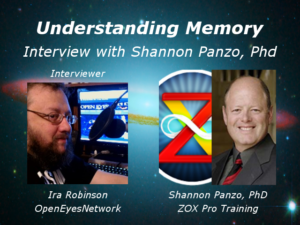
Shannon Panzo Interview - Memory, Hippocampus, Forgetting

Understanding Memory – Shannon Panzo, PhD

 ⇓ ⇓ Video Below ⇓ ⇓

What is memory?

I constantly have people asking me about memory.

Forgetting…

Why do I forget things? Why do I forget what I just read?

Better Memory

How can I make my memory better?

Photographic Memory

How does the photographic memory fit into this?

Short term memory vs long term memory?

Memory Discussion

What happens if you lose your memories? It often happens to people that are elderly. It also happens to people at any age and for many different reasons. Your brain is highly complex and makes trillions of connections each day. It is easy to see how something so complex could easily be derailed.

The best solution are activities that can prevent a complete collapse if things should take a turn for the worse. You can exercise your brain to be stronger. It has been scientifically proven that when you exercise and stress your brain past the threshold of neural plasticity, it triggers your brain to immediately respond by building new pathways, synapse, neurons, and memory. Building this within your brain makes it resilient; resistant to memory loss, Alzheimer’s Disease, and dementia.

I recently was interviewed on the topic of “Taking Control of Your Memory”. If you are interested at all in memory, you should listen to this interview. I cover a lot of topics around memory in the Interview. Even if you do not hear what you need at the start, keep listening. The essential information you need could be covered next. This interview could be the most important thing you have ever heard.

Shannon Panzo Interview – Understanding Memory

Important Points within Interview…

About the Hippocampus…

The short-term memory revolves around a particular structure within the brain is called the hippocampus.

The hippocampus is actually part of the limbic system, a primitive part of the brain; and if you ever want to increase your ability to memorize things, on a conscious level, the hippocampus is stimulated.

The function of the hippocampus is to forget; not to remember. What the hippocampus thinks is not important, it just forgets it. Only ~5 percent of the initial memory is passed over to the long term memory.

There are ways to bypass the hippocampus and actually take in information driving it straight home to the long-term memory where you never forget it; mainly by using the photographic memory you are born with.

Human Memory…

Aboriginal cultures quite often demonstrate they have extensive memory because they have entrained the memories. Because there is no written language they are able to recite the songs of the stories exactly the same way each time for thousands of years. Their natural memory is stronger than the average human that relies on the written language and technical devices that store information. People that tend to take a lot of pictures of their self, where they are, and what they are doing and with whom, often demonstrate incredibly poor memory.

Reading vs. photographic memory

When you learn to read, you are instructed to close off your access to the photographic memory. The two, reading and your photographic memory, are actually in opposition to each other and by doing so you take away something very important to your development.

Information is the key asset to any decision making process. If you have good information your decision-making process is more successful. If you don’t have good information your decision-making process will give you poor output, and it will not be reliable. This is why some people make really great decisions and some people don’t, simply based on the quality of information. Information is treated equally in the brain. It’s the importance at which we bestow upon information as to how our brain treats it.

The Myth about Reading…

The establishment has been lying to everyone about reading, from the start. The lie is very low key. When you are first taught to read, it starts. As a child, you do not have a point of reference to this as non-truth, so you don’t even understand the nature of the lie, “in order to get the information you must read every word verbatim”. As a child, you do not have information to denounce it as a lie, so you accept it through acquiescence. It becomes part of your reality.

Restoring your photographic memory…

As you walk through stores, your photographic memory is being stimulated and exercised. Every store you go into has things setting on the counter and shelves for you to buy. The packaging that those things come in are laden with subliminal advertising. The subliminal advertising actually utilizes your photographic memory to program you to buy stuff. But it also prepares your mind to take over the strengthened photographic memory to use for your own benefit. The method that gives control of your photographic memory back to you is Mental Photography.

After learning Mental Photography with our methods, subliminal advertising simply bounces off. You regain your ability to decide what you choose to buy, instead what others are choosing you to buy. Have you ever bought something you do not want, need, or have a use for? That is result of subliminal advertising. You can change it.

Learning in the Alpha State of Consciousness…

If a child is daydreaming, staring out the window of the classroom while the teacher is talking about whatever the topic is of the day, the child will typically learn so much more than the average person in the class because they’re already in the state of alpha – as they’re looking out the window daydreaming.


Great Things Happen Here!

memory, forget, hippocampus

10 Crazy Facts about Christopher Columbus – Happy Columbus Day

Columbus Day – A Day of Discovery

…plus a Free Brain Management Lesson

Have you ever thought, “I wish I had all the information…” before solving a problem?

We take information for granted, and it can undermine our results when we do. Here is an example of just how facts can change the way you think about things, or change the way you go about solving problems

Discovery…

In the 1400s, it was a very different world than what we live in today. Filth, rats, and disease were considered normal. So it is not surprising that some of the facts about Christopher Columbus may shock you…

Did you know Christopher Columbus was a pirate and slave trader, and was taken back to Spain in chains? Discover this and more. Facts build Truth.

Happy Columbus Day!

Columbus Slave Trader

Christopher Columbus Discovers America?


10 crazy facts about Christopher Columbus…

(There are other shocking facts too, but I stopped at 10.)

  1. Christopher Columbus DID NOT discover the main land mass of America. He only discovered the West Indies; which he named such, believing he had reached the western edge of India. He never set foot on the mainland of North America.

2. The first sight of land was on October 12, 1492. This island in the Bahamas (Caribbean) was named Rodrigo de Triana. It is now called San Salvador.

3. Before getting his commission and setting off to discover the trade route, Christopher Columbus was a PIRATE and made a living attacking other ships.

4. Christopher Columbus became a SLAVE TRADER.  He pioneered the American Slave Trade. Excerpts from Columbus’ logbook note that the natives “…would make fine servants. With 50 men we could subjugate them and make them do whatever we want.” He later wrote, “Let us in the name of the Holy Trinity go on sending all the slaves that can be sold.”

5. Columbus destroyed the native population of Haiti (the Taino Indians); mainly through contagious diseases; but also forced gold taxation leading to torture, murder, suicides and the like. He then began shipping African slaves to the island, which has had consequences reaching into modern day.

6. The birth name of Christopher Columbus was Cristoforo Colombo. He was born in Italy.

7. The crew of the first voyage consisted of 24 men for the Nina, 26 for the Pinta, and 40 for the Santa Maria. There were NO WOMEN allowed.

8. The name of Columbus’ ship “Pinta”, is Spanish for “Prostitute”.

9. Half of Columbus’ voyages ended in disaster. On his first voyage (1492), his fully outfitted flagship, the Santa Maria, ran aground and sank. On his fourth trip, his ship rotted away and he spent a year with his men marooned on Jamaica.

10. Christopher Columbus has been viewed as an intrepid explorer, a monster, and a slave trader; who unleashed horrors and conquest upon unsuspecting natives. He was the first in a long line of many in the continued conquest of the Americas. However, scholars note #Columbus had both admirable qualities and negative ones: even though it appears he was brave, Columbus is also seen as a very flawed human being.

In Columbus’ day, things were looked at differently. He was probably seen as a hero, and in some ways a good business man. Even to this day, some of his achievements are still celebrated in his name. But over time, the facts about him and his achievements have been blurred and forgotten by the masses. Does it make Columbus any less of a man? That is for you to decide.

Your Brain Management Lesson:

Quality Information = Great Decisions

Don’t take information for granted. There are hidden facts underneath the truth. #Discover the facts. Good decisions are important to your quality of life. If you make your decisions based upon the masses, you get mediocre results. If you have poor information, you will make poor choices. If you approach problems with wisdom gained from the facts, your decisions will have the best results.

With all the decisions you must make daily, it is difficult to glean all the information you need, if you rely on reading and speed reading. The speed at which you absorb the information is relatively slow. You experience a bottleneck. You know you can get information much faster, but your technique is holding you back. But there is something in your brain that makes it 100 times more difficult — your short term memory.

Short Term Memory = Hippocampus

The processing to handle short term memory is done by the hippocampus. In short, the job of the #Hippocampus is to FORGET; not to remember. Your hippocampus chooses what bits are important (only 5%) and forgets the rest. This is why most people claim, “I forgot what I just read.” And only the 5% is what makes it into your long term memory.

Teachers in the educational system give you a heap of remedies to increase your long term memory of the information you gather. But, all of them consume time. Time is the one thing you cannot get back or replace. It is gone. You need a system that that outperforms the learning system you are taught in school; to STOP forgetting the information you must remember.

Plug into Your Matrix…

Until “plugging in” to get your information downloaded, like in the movie, “The Matrix” becomes commonplace, you need a system utilizing your photographic memory, that uses your brain in the same fashion; but without all of the gimmicks.

You can set your brain in motion in incredible ways to get fantastic results. This is done through a series of brain building exercises. The ordinary exercises like Sudoku, crossword puzzles, and such are not enough to overcome the stress threshold you need for neuroplasticity to occur; or the point at which your brain automatically triggers growth of more neurons and synapse. That is where Mental Photography (ZOXing) comes in. It provides the stimulus needed to move you above and beyond the growth threshold of #Neuroplasticity.

Summary:

To make your best decisions, you need A-Grade Quality Information.

To get A-Grade quality information fast, you must be using your #PhotographicMemory through your subconscious.

To gain the best results with your memory and all-round brain function, you must use brain exercises that are capable of triggering neuroplasticity to occur.

Or you can continue to lead a mediocre life using mediocre information to make your mediocre decisions. It takes no effort. Just continue to do things the old-fashioned way you were taught by your teachers at school.

The Day of Discovery

You owe it to yourself to get the best possible tools to make the best decisions in your life along the way.

The result proven tools we offer are presented in ZOX Pro Training (Internet only), Brain Management Home Study (Traditional CDs and books and study guide), Brain Management Seminar, and eBrain Executive Seminar (Australia only).

Discover yourself! (...and have a nice Columbus Day)

Shannon Panzo, PhD

Great Things Happen Here!

 Columbus’ Discovery