
Photographic Memory — Keys to Success

Photographic Memory and Genius…

photographic memory

Photographic Memory is also known as “Eidetic Memory.”

So just what IS photographic memory? It’s a secret you’ve had since before you were born! If you still don’t understand, look to your children.  They will show you the way.

The infant brain develops even in the womb. Experts say you should read to your children as soon as they are born for quality stimulation of their natural learning abilities. As a child ages through that first crucial year of life, they are learning how to learn. The more stimulation – the more learning capacity the child will have.

Some people with photographic memory retain their photographic memory into adulthood. If you aren’t one of those people, why not? The answer will SHOCK you.  Are you ready?

Learning Begets Learning

One word. Reading. You see, we never lose our photographic memory. But many of us lose the ability to USE it, or more accurately, we lose access to it. You learned amazing things as a small child – languages, social skills, etc.

THEN, you went to school to learn a superior way to learn – or so we’re told.  Statistics show that once we enter school and become entrenched in the rote-memory system of learning; learning slows from that point on.

Your Inner Child Genius

The truth is, you were force fed learning to read, or you were ostracized. Some of those renegades who endured being ostracized are the same ones who have retained their photographic memories as adults.

Reading is  a brain function that encourages tunnel vision, which is directly opposed to your natural ability to access and use your photographic memory.

But with Mental Photography you can learn how to access your photographic memory and how to develop a photographic memory fast, and regain the genius you had as a child. By exercising your brain this way, you may see other things start to happen – and you don’t have to give up reading, either!

Your Future Starts NOW!  
Shannon Panzo

Great Things Happen Here!

The Photographic Memory – A Picture is Worth a Thousand Words

A Picture is Worth a Thousand Words …

photographic memory, eidetic memory, google, zox pro training

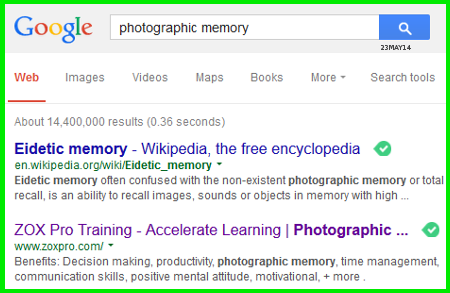
Google.com search for Photographic Memory


The Photographic Memory …

ZOX Pro Training has been teaching people how to use their photographic memory since 1975. The parent organization, Educom, Inc., has  been teaching the Mental Photography techniques in Brain Management training since the beginning. We released ZOX Pro Training onto the Internet in 2008. People around the world have benefited that would have never had access to our training otherwise.

The Picture …

The Google.com search pictured above is a snapshot of ZOX Pro Training’s unique place in the industry of alternative learning. Our techniques accelerate learning to all new levels that most people find incredible, starting at 25,000 words per minute. The brain exercises taught within the training strengthen your brain, gaining clarity, and the way it functions naturally by way of what is now referred to as neural-plasticity.

This picture signifies recognition by the Internet, and portrays the quality Richard Welch, the “Father of Mental Photography” had envisioned 39 years earlier.

The Eidetic Memory …

People are often confused by the difference between the eidetic memory and the photographic memory (eidetic memory vs photographic memory). You are born with the eidetic memory. This is how you learn everything when you are very young till around the age of 5. When you are born, you are a genius; an information sponge absorbing information faster than light speed, naturally, and with ALL of your senses. The best thing is you never lose your eidetic memory and the abilities it gives you. Most people are taught out of using it fluently.

The first recorded use of the words “photographic memory” is 1924. But we also know there are plenty of people from history before that time that demonstrate these abilities. Why then do many psychologists find the term so easy to discredit? First, and probably most importantly, the word “photographic” only refers to the visual sense, while “eidetic” refers to ALL of your senses. How silly! Someone was not able to remember the technical term “eidetic memory” so they simply made up a word close to the same meaning – the “photographic memory”.

Since the amount of information your brain takes in from vision is over ten times that of all of your other senses combined, it could easily be used as a relevant exchange word. But the carryover to this day has missed the original meaning, which is relevant to all of your senses. So, now when the psychologists and brain researchers are looking for the people with photographic memory, they are looking at a flawed model of what it is meant to actually represent.

So, in more concise terms, the word “photographic memory” does not exist. We use the word photographic memory for our services because that is what the rest of the world is commonly using, albeit improperly. There are many scholars that study how words within languages have changed over time. Often times, a process like this creates a new word or usage.

Thanks!

We would like to thank you, the person that enjoys getting news on the further applications and developments of our trainings. We encourage every one of you to power-up your brain, and make it your best asset for your future.

Shannon Panzo, PhD

Great Things Happen Here!